


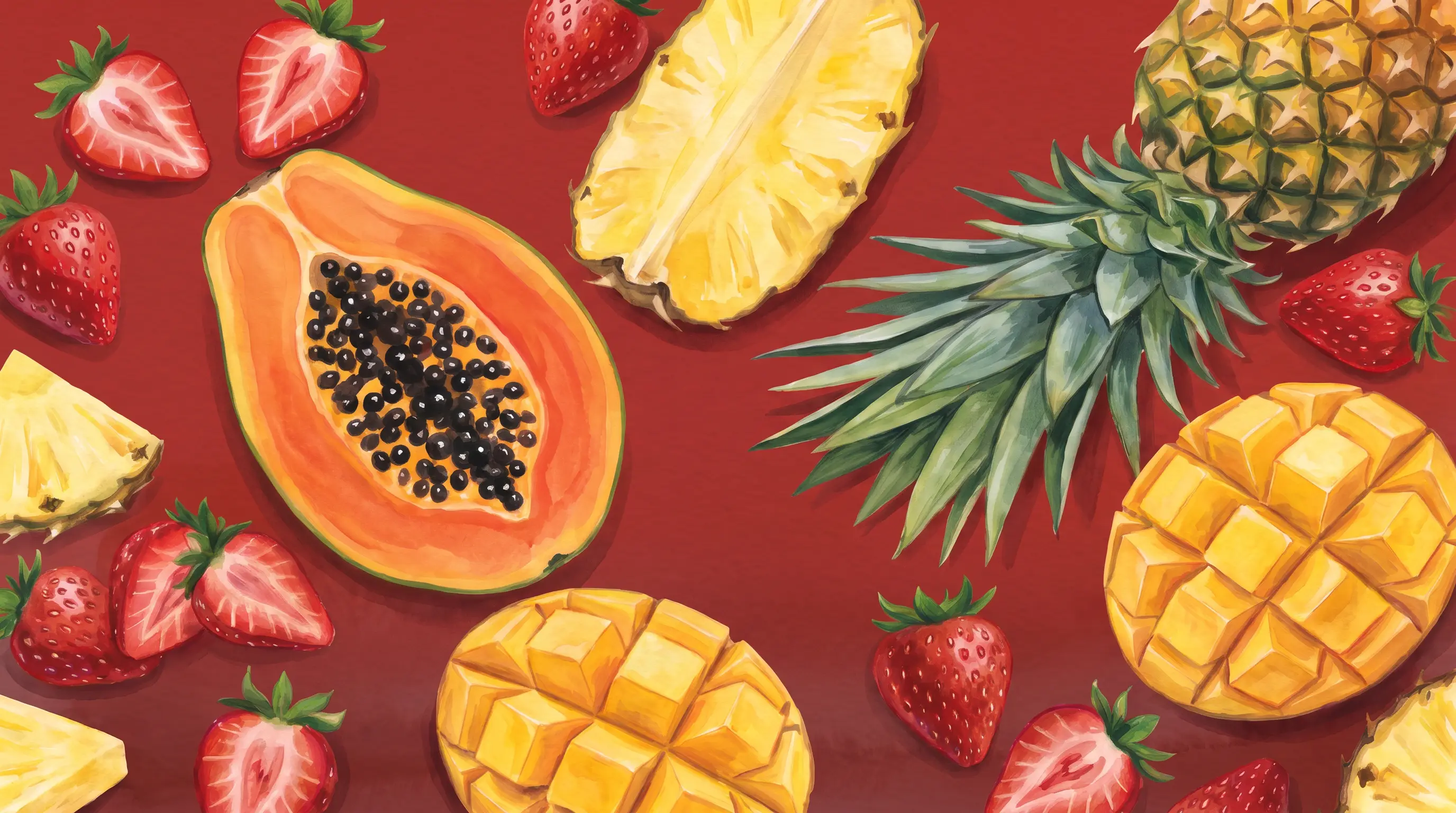
Ask most people for the best fruits for your immune system and you'll hear one answer: oranges.
Oranges are a fine choice. But cup for cup, some of the fruits sitting in your freezer deliver just as much vitamin C, and a few bring extra nutrients oranges don't.
In this guide, we rank four everyday fruits by how much vitamin C you get in one cup, using USDA nutrition data. You'll see what each one adds besides vitamin C, whether frozen fruit holds on to its vitamin C, and how to combine them to cover your full daily value in one smoothie.
Let's dive right in.
Table of Contents
- The Short Answer: Fruits Ranked by Vitamin C
- Why Vitamin C Matters for Your Immune System
- 1. Strawberries
- 2. Papaya
- 3. Pineapple
- 4. Mango
- Does Frozen Fruit Keep Its Vitamin C?
- How to Build an Immune-Boosting Smoothie
- For Foodservice and Manufacturers: Putting It on the Menu
- FAQ
The Short Answer: Fruits Ranked by Vitamin C
Adults need about 90 mg of vitamin C a day, which is also the Daily Value (DV) you see on nutrition labels, according to the NIH Office of Dietary Supplements. Here's how four fruits high in vitamin C compare, and how much of that daily value one cup of each covers.
| Rank | Fruit (1 cup) | Vitamin C | % Daily Value | Other standouts |
|---|---|---|---|---|
| 1 | Strawberries, halves (152 g) | 89 mg | 99% | Fiber, manganese |
| 2 | Papaya, pieces (145 g) | 88 mg | 98% | Folate (13% DV) |
| 3 | Pineapple, chunks (165 g) | 79 mg | 88% | Manganese (67% DV) |
| 4 | Mango, pieces (165 g) | 60 mg | 67% | Folate (18% DV), vitamin A (10% DV) |
Source: USDA FoodData Central (SR Legacy), raw fruit. Daily Value: 90 mg vitamin C.
Bottom line: strawberries and papaya each cover almost a full day of vitamin C in a single cup. Pineapple and mango aren't far behind, and each brings its own extra.

Why Vitamin C Matters for Your Immune System
Vitamin C is an antioxidant, and according to the NIH, it "plays an important role in immune function." It also helps your body make collagen and absorb iron from plant foods.
Two things make it worth paying attention to every day:
- Your body can't make it. Unlike most animals, humans have to get vitamin C from food.
- It's water-soluble. Your body doesn't build up large reserves, and what it doesn't use is flushed out. Steady daily intake matters more than a big dose once in a while.
One honest note: vitamin C supports normal immune function, but it isn't a cure. Research summarized by the NIH found that taking vitamin C regularly didn't lower the chance of catching a cold for most people, though it slightly shortened how long colds lasted. Think of these fruits as part of a balanced diet that keeps your immune system supplied, not as medicine.
1. Strawberries

Vitamin C: 89 mg per cup of halves (99% DV)
Strawberries top this list. So how much vitamin C in strawberries, exactly? One cup of halves gives you 89 mg, nearly your whole day's worth, for about 50 calories. That makes them one of the most nutrient-dense fruits you can eat.
They also bring about 3 grams of fiber per cup, plus manganese, folate and a family of red plant pigments called anthocyanins.
Strawberries are also one of the easiest fruits to use frozen. They blend smoothly into smoothies and shakes, swirl into yogurt and oatmeal, and turn into sorbet with just a few ingredients (try our 3-ingredient strawberry sorbet).
More on sourcing: IQF strawberries.
2. Papaya

Vitamin C: 88 mg per cup of pieces (98% DV)
Papaya is the fruit most people forget, and it nearly ties strawberries. Papaya's vitamin C content comes to 88 mg per cup.
It's also a good source of folate, a B vitamin your body uses to make new cells, with 13% of the DV per cup. Its soft, buttery texture and mild tropical flavor make it an easy base for smoothies and bowls, where it adds sweetness without overpowering other fruit.
More on sourcing: IQF papaya.
3. Pineapple

Vitamin C: 79 mg per cup of chunks (88% DV)
Pineapple's vitamin C content lands just under 80 mg per cup. Where it really stands out is manganese: one cup covers 67% of your daily value. Manganese is a mineral your body uses in many enzymes, including some that help protect cells from oxidative stress.
Pineapple also contains bromelain, a group of enzymes found mainly in the fruit and stem. Its bright acidity balances sweeter fruits, which is why it shows up in so many smoothie and juice blends (see our guide to the best fruits for juicing).
More on sourcing: IQF pineapple.
4. Mango

Vitamin C: 60 mg per cup of pieces (67% DV)
Mango's vitamin C is the lowest of the four, but it's still a strong source: 60 mg per cup is two-thirds of your day.
What mango adds is range. One cup gives you 18% of the DV for folate, the highest of the group, plus 10% for vitamin A, which also plays a role in normal immune function. It's also the crowd favorite, so it's often the fruit that gets people to eat the others.
More on sourcing: IQF mango, or see our IQF mango buyer's guide.
Does Frozen Fruit Keep Its Vitamin C?
This is the question we hear most, and the short answer is yes, for the most part.
Vitamin C is one of the more fragile nutrients. It breaks down with time, heat, light and air. That's exactly why the hours after harvest matter. Fresh fruit keeps losing vitamin C while it travels and sits in the fridge.
IQF (individually quick frozen) fruit is frozen soon after harvest, which slows that loss way down. A study in the Journal of Food Composition and Analysis (Li et al., 2017) compared fresh, fresh-stored and frozen produce, including strawberries. In most comparisons, the researchers found no significant difference in vitamin content. When there was a difference, frozen produce more often came out ahead of produce that had been stored in the fridge for a few days.
Getting the most vitamin C from frozen fruit: use it straight from frozen when you can (smoothies, bowls, sorbets), avoid long thawing on the counter, and add it at the end of cooking rather than simmering it for a long time. If you do thaw fruit, use the juice too, since that's where some of the vitamin C ends up.
For a deeper comparison, read fresh vs. frozen fruit: which is actually better for you?
How to Build an Immune-Boosting Smoothie
The easiest way to put this list to work is a smoothie. Because all four fruits blend well from frozen, you can combine them to hit your full daily value in one glass.
| Blend | What goes in | Vitamin C | % Daily Value |
|---|---|---|---|
| Tropical | ½ cup each papaya, pineapple and mango | 114 mg | 126% |
| Berry tropical | ½ cup each strawberries, papaya and mango | 119 mg | 132% |
| All four | ½ cup each strawberries, papaya, pineapple and mango | 158 mg | 176% |
Fruit only, based on the per-cup values above. Add your choice of liquid, yogurt or ice.
A few tips for a better blend:
- Use frozen fruit instead of ice. You get a thick texture without watering down flavor or nutrients.
- Balance sweet and tart. Pineapple or strawberries brighten mango and papaya, which are both mellow and sweet.
- Add protein or fat if it's a meal. Greek yogurt, nut butter or seeds make it more filling.
For Foodservice and Manufacturers: Putting It on the Menu
Interest in immune-supporting foods tends to rise every fall and winter, and fruit-forward drinks and bowls are an easy way to meet it. A few things to keep in mind:
- Lead with real numbers. "A full day of vitamin C" is more convincing on a menu board than vague wellness language, and it's easy to back up with the data above.
- Know the label rules. In the US, a product can be called a "good source" of a nutrient at 10 to 19% of the DV per serving, and "high in" or an "excellent source" at 20% or more, under FDA rules (21 CFR 101.54). Claims about immunity are more tightly regulated, so check wording with your regulatory team before printing anything.
- Keep it consistent. IQF fruit is frozen at peak ripeness, so color, sweetness and nutrition stay steady from batch to batch and season to season.
More on this segment: frozen fruit for foodservice and frozen fruit for beverages.
FAQ
What fruit has the most vitamin C?
Among common fruits, guava has the most, with about 377 mg per cup. Of the fruits in this guide, strawberries rank highest at 89 mg per cup, with papaya right behind at 88 mg.
How much vitamin C do I need per day?
The recommended amount is 90 mg a day for adult men and 75 mg for adult women, according to the NIH. Nutrition labels use 90 mg as the Daily Value.
Is frozen fruit as good as fresh for vitamin C?
In most cases, yes. Research comparing fresh, fresh-stored and frozen produce found no significant difference in vitamin content in most comparisons, and frozen often beat fruit stored in the fridge for a few days.
Can fruit prevent colds?
No food prevents colds on its own. Vitamin C supports normal immune function, and getting enough every day is part of a healthy diet, but research hasn't shown that it stops most people from catching a cold.
The Bottom Line
You don't need exotic superfoods to cover your vitamin C. One cup of strawberries or papaya gets you almost all the way there, and pineapple and mango add manganese, folate and vitamin A on top. Keep a few bags in the freezer and a full day of vitamin C is one blender away, any time of year.
Want this fruit in your own products? Patagonia Foods supplies IQF strawberries, papaya, pineapple and mango, frozen at peak ripeness and packed at the source. Request a quote to get started.

