


Buying frozen mango sounds simple until the first container arrives and the product doesn't behave the way you expected on your production line. Diced pieces that break apart on thaw. A Brix level lower than what your smoothie or filling needs. Inconsistent sizing that jams up automated filling.
Most of these problems have nothing to do with the mango itself. They come from a purchase made without specifying the right format and specs upfront.
In this article, we walk through the IQF mango formats available, the quality specs you should require depending on your use case, and the questions to ask a supplier before you buy. Let's get into it.
In this article:
- What is IQF mango, and why format changes the outcome
- The formats available and what production each one fits
- The quality specs you should require (and how to read them)
- Key questions for your supplier before you buy
- Red flags to watch for when evaluating a lot or a supplier
What Is IQF Mango, and Why Does Format Matter?
IQF stands for Individually Quick Frozen. Each piece of mango is frozen separately, within minutes, instead of frozen together in a block.
The result: pieces don't clump together, the fruit keeps its texture, and you can portion exactly what you need without thawing the whole lot.
But "IQF mango" isn't one thing. The format you buy it in determines whether it works well, or poorly, in your process.
Buyer tip: before you request a quote, map out your production process first. The right format depends on how you'll use the fruit, not on what the supplier happens to have available that month.
IQF Mango Formats Available
Diced (Chunks)
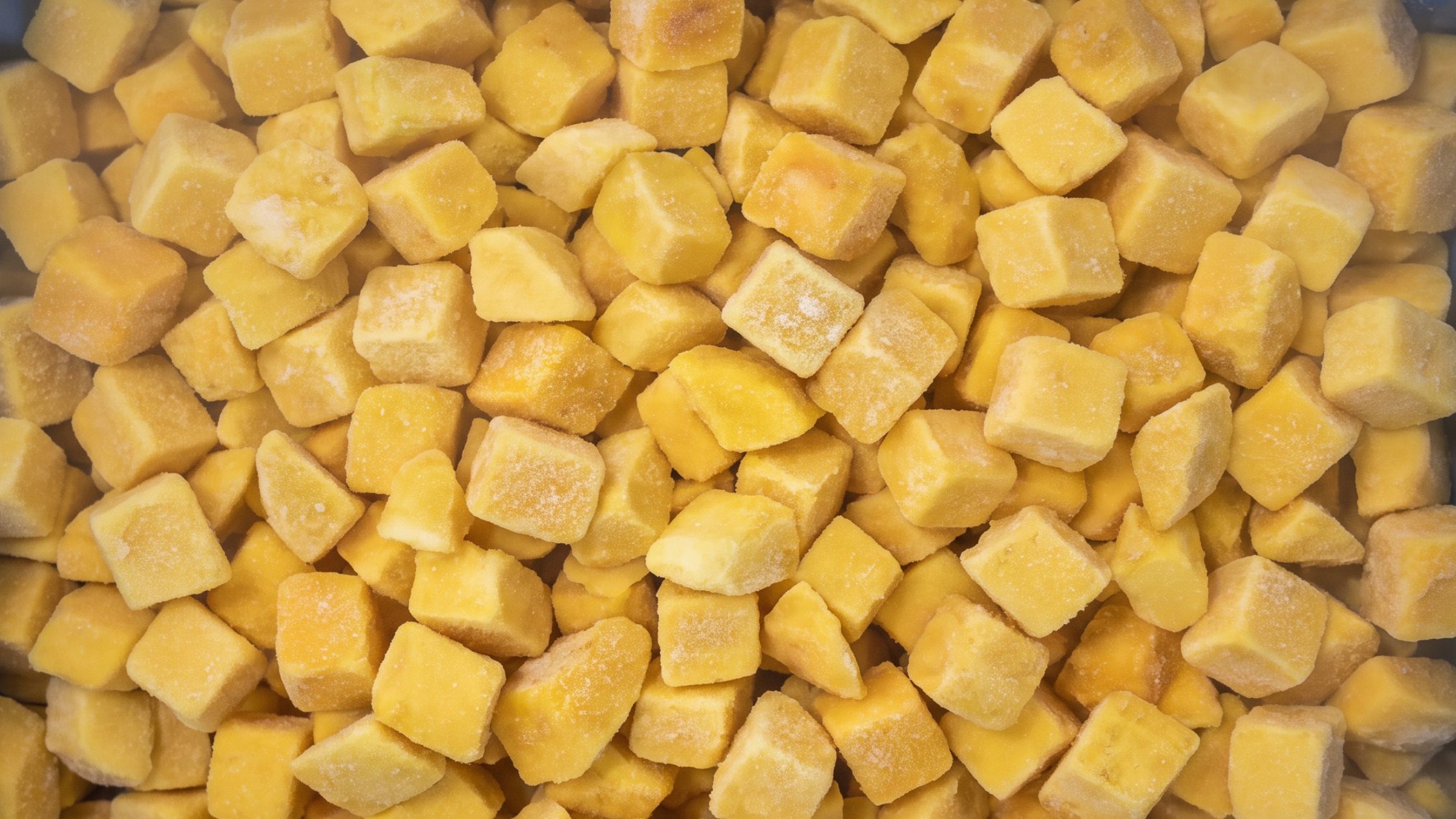
The most common B2B format. Cut into standard cube sizes, typically 10x10 mm, 15x15 mm, or 20x20 mm.
Works well for: smoothies, fruit piece yogurts, baked goods, mixed frozen fruit blends.
What to check: size consistency piece to piece. A lot with widely varying cube sizes throws off automated dosing and the visual yield of your final product.
Slices
Larger, flat cuts used when the fruit's visual presentation matters: desserts, toppings, and products where the end consumer sees the mango piece itself.
What to check: uniform thickness and the absence of broken or chipped pieces in the pack.
Frozen Purée
Mango processed and frozen in liquid or semi liquid form, packed in drums or aseptic bags.
Works well for: beverages, sauces, ice cream bases, and products where you don't need a whole piece.
What to check: the purée's Brix level, and whether it contains additives. Some purées include added sugar or citric acid, so ask for the spec sheet to confirm.
Whole or Halved IQF Mango
Less common in B2B, used mainly by processors doing their own cutting or formulation.
What to check: whether the pit was fully removed. A reliable supplier confirms this in writing on the spec sheet.
Quality Specs You Should Require
Don't buy IQF mango on price and format alone. Quality specs are what determine whether a lot will actually perform consistently in your production.
Brix (Sugar Content)
Brix measures the fruit's sugar content: the higher the Brix, the sweeter the fruit naturally is. For mango, a solid lot typically falls between 13 and 17 °Brix, depending on variety and harvest timing.
If your final product depends on the fruit's natural sweetness (smoothies, purées with no added sugar), ask for Brix by lot, not a general average across the supplier's product line.
Sizing and Cut Consistency
Cube or slice size should stay consistent within a lot and across lots. Ask for the tolerance range in millimeters; a supplier with a controlled process can give you this without hesitation.
Color and Variety
Color varies by mango variety (Tommy Atkins, Kent, Ataulfo, Keitt). If your product needs a specific color, specify the variety on your purchase order, not just "mango."
Allowed Defects
Every lot carries a defect tolerance: broken pieces, skin remnants, discoloration. Ask for the maximum percentage allowed; it should be documented, not a verbal answer.
Certificate of Analysis (COA) per Lot
This is the difference between knowing what you bought and just hoping it's fine. A per lot COA should include Brix, microbiological counts, and heavy metals results if your market requires them.
What a real COA should include:
- Lot number and production date
- Actual Brix for that lot (not a generic range)
- Microbiological test results
- Net weight and moisture tolerance
- Lab signature or seal, in house or third party
Questions to Ask Before You Buy
Before you close with an IQF mango supplier, these are the questions that separate an informed purchase from a gamble:
- Is the COA per lot, or a generic product sheet? If it's generic, you don't actually know what you're receiving.
- What mango variety is this, and why was it chosen for this format? Variety affects color, Brix, and firmness after cutting.
- What's the sizing tolerance for the dice or slices? Ask for the number in millimeters, not "consistent sizing."
- What's the guaranteed shelf life, and under what storage conditions? At −18°C, typical shelf life for IQF mango runs 18 to 24 months.
- What happens if a lot doesn't meet the agreed spec? The answer tells you whether the supplier takes responsibility or leaves the problem with you.
- How does availability shift by season? Mango has specific harvest windows depending on origin; a reliable supplier tells you this before it affects your production, not after.
Red Flags When Evaluating a Supplier
- They can't provide a per lot COA, only a general product spec sheet.
- The quote doesn't specify a mango variety.
- The price is well below the rest of the market with no explanation (this usually means inconsistent sizing or a higher defect tolerance).
- They avoid discussing seasonality, as if mango were available year round with no shift in price or quality.
- There's no clear answer for what happens when a lot arrives out of spec.
The Bottom Line
The right IQF mango for your production comes down to three decisions: the format (dice, slices, purée, or whole), the quality specs you require (Brix, sizing, defects, per lot COA), and the questions you ask before you buy, not after the container arrives.
Ready to spec your next IQF mango lot? Request a quote with a sample spec sheet and COA included, or contact our sales team to work through the right format for your production.

