


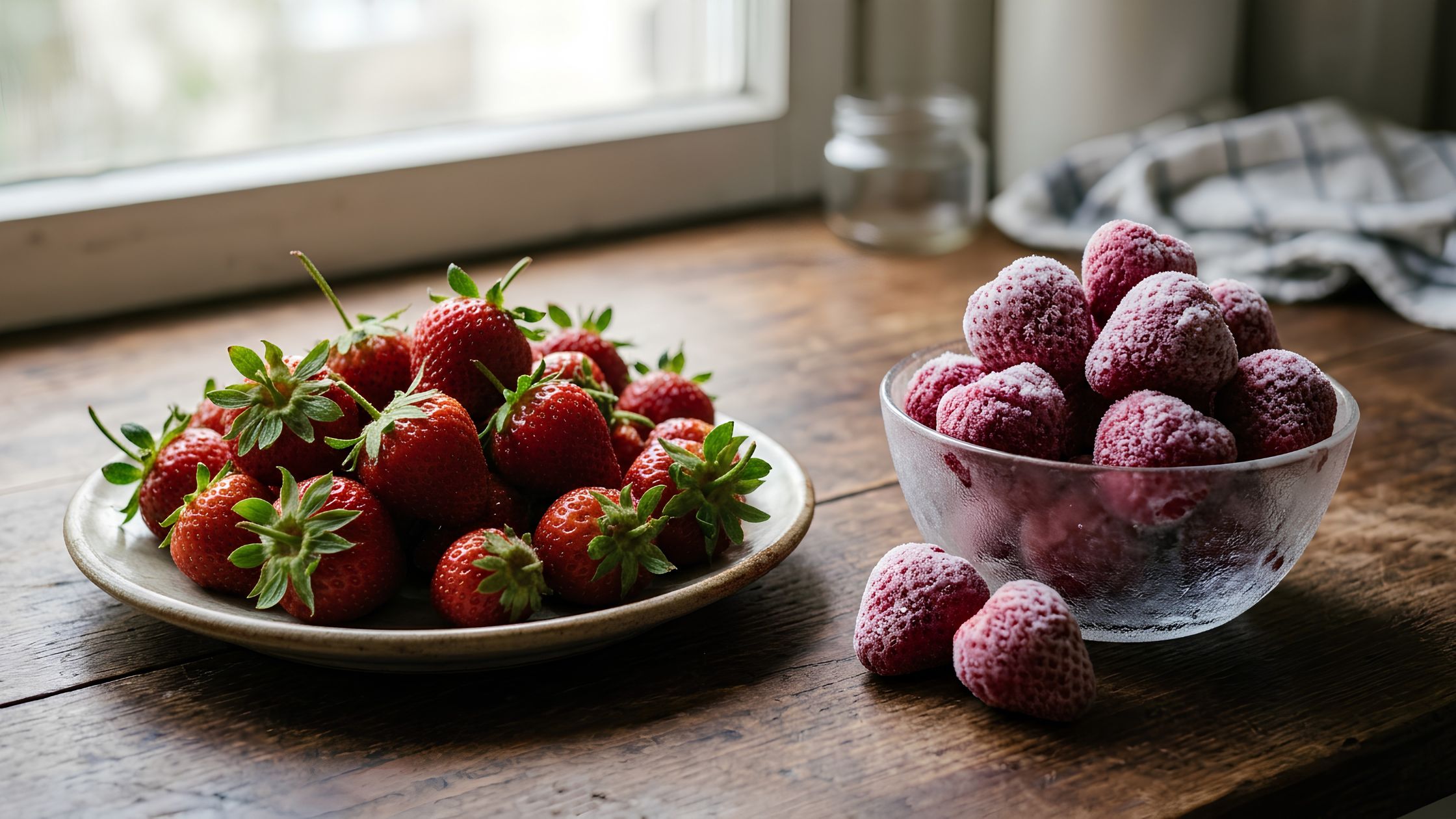
You're standing in the grocery store, staring at a pint of fresh strawberries next to a bag of frozen ones. The fresh berries look better. They smell like summer. But they also cost more, and you know from experience that half of them will be mushy by Thursday.
So which one is actually better for you?
The short answer: frozen fruit is often just as nutritious as fresh, and sometimes it's more nutritious. That surprises a lot of people, because "fresh" has become shorthand for "healthy" and "frozen" gets filed under "processed." But the nutrition science doesn't back that assumption up.
Here's what actually happens to fruit nutritionally between the farm, the freezer, and your kitchen.
The Real Difference Is Timing, Not Freshness
Fresh fruit at the grocery store isn't as fresh as it looks. Most fruit is picked before it's fully ripe so it can survive shipping, then it sits in trucks, warehouses, and store shelves for days or weeks before you buy it.
Frozen fruit works differently. It's typically picked at peak ripeness, when nutrient content is highest, and frozen within hours using a process called IQF, or individually quick freezing. Each piece freezes fast and separately, which locks in nutrients close to the moment of harvest.
That timing gap matters more than people think. Vitamin C, for example, starts breaking down as soon as fruit is picked. A study from the University of California, Davis found that some fresh produce loses meaningful amounts of vitamin C within a week of harvest, especially if it's stored at room temperature.
So the real comparison isn't fresh versus frozen. It's fruit picked ripe and frozen immediately versus fruit picked early and shipped for days.
What the Research Actually Shows
Several studies have compared nutrient levels in fresh and frozen produce directly, and the results are consistently close.
A widely cited study published in the Journal of Food Composition and Analysis compared fresh and frozen fruits and vegetables across several nutrients, including vitamin C, folate, and antioxidants. The researchers found no significant nutritional advantage for fresh produce overall, and in some cases, frozen samples had higher nutrient levels.
Antioxidants tend to hold up especially well in frozen fruit. Berries, in particular, retain most of their antioxidant capacity through the freezing process, because freezing slows the enzymatic activity that normally degrades those compounds over time.
None of this means fresh fruit is bad for you. Fresh fruit eaten shortly after harvest is excellent nutritionally. The point is that "fresh" sitting in a shipping container for two weeks isn't automatically better than "frozen" processed within hours of picking.
Quick reference: what changes and what doesn't
- Vitamin C: Can be similar or slightly lower in frozen fruit, but the gap is often smaller than the loss fresh fruit experiences during storage.
- Fiber: Essentially unchanged by freezing.
- Antioxidants: Well preserved in frozen fruit, particularly berries.
- Texture: This is where frozen fruit does lose ground, since ice crystal formation breaks down cell walls.
Where Frozen Fruit Actually Wins
There are a few areas where frozen fruit has a real, practical edge over fresh.
Cost. Frozen fruit is almost always cheaper per serving, and prices don't spike out of season the way fresh fruit does. Frozen mango in December costs roughly the same as it does in June.
Waste. Fresh fruit spoils. The USDA estimates that produce accounts for a large share of household food waste, much of it from fruit going bad before it gets eaten. Frozen fruit stays usable for months, so you use exactly what you need and nothing goes in the trash.
Availability. Frozen fruit gives you access to produce outside its growing season without relying on fruit shipped from the other side of the world and picked weeks early to survive the trip.
Consistency. Because frozen fruit is processed close to harvest under controlled conditions, quality and ripeness are more consistent from bag to bag than fresh fruit tends to be from one grocery trip to the next.
Where Fresh Fruit Still Has the Edge
Frozen isn't better in every situation, and it's worth being honest about where fresh wins.
Texture is the biggest one. Freezing forms ice crystals inside the fruit's cells, and when it thaws, those cells rupture. That's fine for a smoothie or a baked good, but it's the reason thawed frozen strawberries turn soft and watery instead of staying crisp like a fresh one.
If you're eating fruit raw, on its own, for the texture as much as the taste, fresh is usually the better call. Local, in-season fresh fruit that hasn't traveled far also tends to taste better and hold its nutrients well, since it hasn't spent much time between harvest and your kitchen.
A simple way to decide
Ask yourself what you're using the fruit for. Eating it whole, out of hand? Fresh, in season, is hard to beat. Blending it, baking it, or cooking it down into a sauce? Frozen works just as well nutritionally and usually costs less.
So, Which One Is Actually Better?
Neither wins outright, because they're not really competing on the same axis. Fresh fruit's advantage is texture and, when it's truly in season and local, taste. Frozen fruit's advantage is nutrient retention relative to how it's usually shipped and sold, plus cost, consistency, and lower waste.
If you're trying to hit your fruit intake for the week without spending a fortune or throwing half of it away, frozen fruit is a legitimate, science-backed choice, not a compromise. If you're eating fruit for the experience of eating it fresh off the stem, buy fresh and eat it soon after you buy it.
The healthiest approach for most people is using both, depending on the moment. Fresh for snacking, frozen for smoothies, oatmeal, and baking, where texture doesn't matter and consistent quality does.
If you're sourcing frozen fruit for a food business rather than your own kitchen, the quality gap between suppliers is real, and it comes down to how and when the fruit is frozen. Get in touch with our team to talk through your specifications, or request a quote to see current pricing and availability.

