


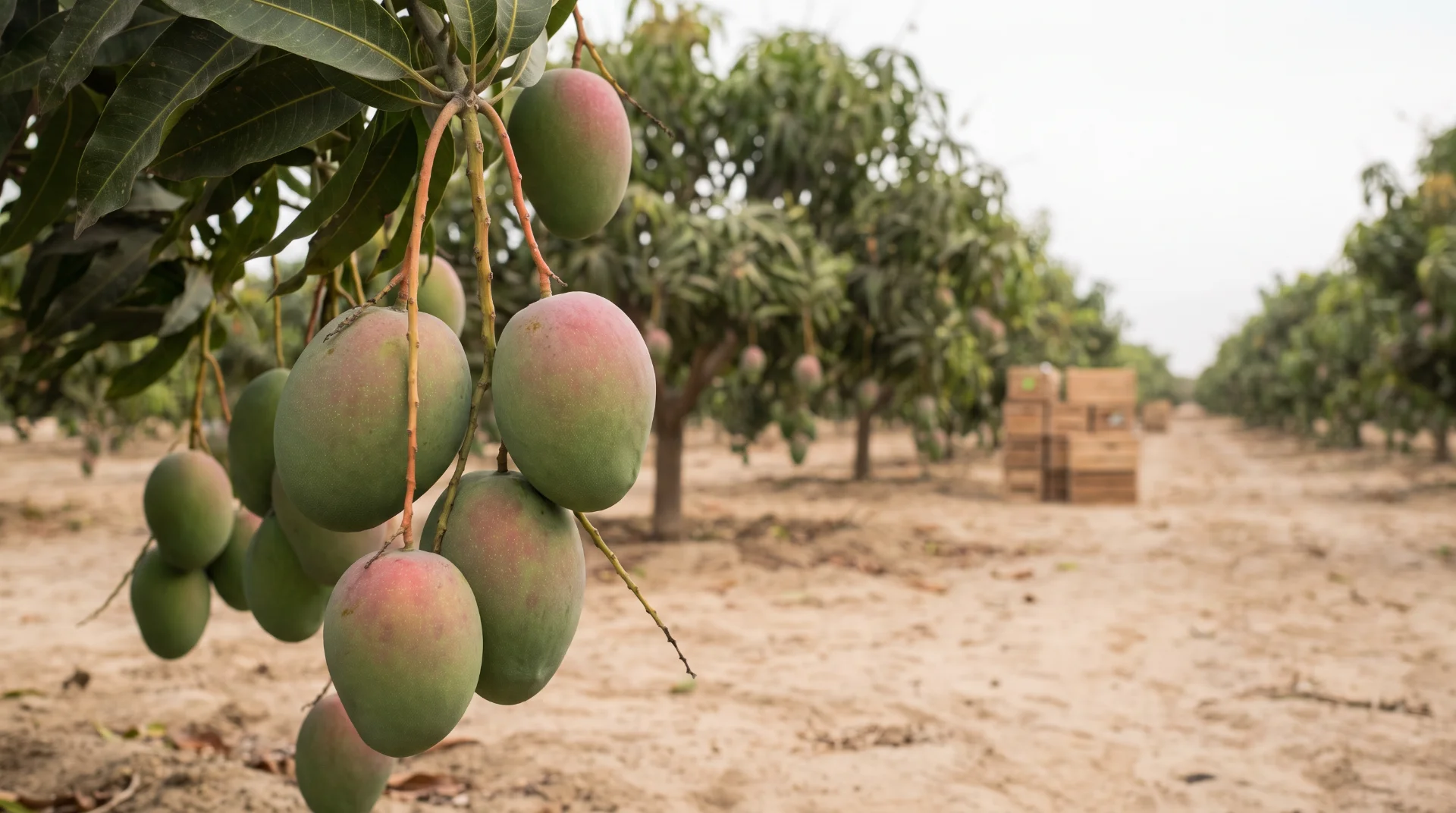
If you buy frozen mango, the next few months matter. Peru's mango season is underway, and Peru is one of the main suppliers of fruit during the Northern Hemisphere winter.
This year, though, the crop is a lot smaller than usual.
Here's the short answer: Peru's mango season runs from about November to March, peaks in January, and frozen mango processing follows the fresh harvest. For 2026/27, Peru's mango association expects fresh exports to drop about 40% from last season.
In this guide, you'll see when the Peru mango season starts in each growing region, when frozen mango production ramps up, how small this year's crop is, why it happened, and what it means for your frozen mango supply into 2027.
Let's dive right in.
Table of Contents
- When Is Mango Season in Peru?
- Peru Mango Season by Region
- When Does Frozen Mango Season Start?
- Which Mango Varieties Does Peru Grow?
- The 2026/27 Crop: How Much Smaller?
- Why Is the Crop So Small?
- What It Means for Frozen Mango Buyers
- 5 Ways to Plan Your 2027 Mango Supply
- Mango Season Around the World
- FAQ
When Is Mango Season in Peru?
Peru grows its mangoes on the dry northern coast, and the harvest moves south as the season goes on. In a normal year, the campaign starts in early November and runs until March, with production peaking in January (FreshPlaza).
The order is always the same:
- Piura opens the season and supplies most of the fruit.
- Lambayeque (Motupe and Olmos) follows as Piura winds down.
- Casma, in Áncash, closes the season, and in some years ships into April.
That timing is what makes Peru so important. From December to February, Peru has few competitors in the market, so it's the main source of Kent mango for the US and Europe in those months.
Peru Mango Season by Region
Each region peaks at a different time. Here's how the 2026/27 season breaks down, using the projections from APEM, the Peruvian Association of Mango Producers and Exporters (Agraria.pe):
| Region | Share of 2026/27 exports | Peak shipping | Typical window |
|---|---|---|---|
| Piura | About 70% (94,382 t) | Weeks 1 to 3 (early January) | November to February |
| Lambayeque (Motupe, Olmos) | About 16% (21,000 t) | Weeks 6 to 7 (February) | January to March |
| Casma (Áncash) | About 15% (19,800 t) | Weeks 9 to 10 (early March) | Late December to March, sometimes April |
Sources: APEM via Agraria.pe, Nov 2 2026; FreshPlaza. Windows are typical and shift a few weeks from year to year.
The big takeaway: Piura is the season. When Piura has a bad year, Peru has a bad year, because the other two regions can't make up the difference.
When Does Frozen Mango Season Start?
Frozen mango doesn't have its own harvest. It comes from the same orchards as fresh mango, so IQF production follows the fresh season, usually a few weeks behind it.
In a typical year in Peru:
- November to December: processing starts with Edward mangoes, an early variety that's popular for processing.
- December to mid-March: Kent, the main variety for frozen, carries the bulk of production as Piura, Lambayeque and Casma come in.
Frozen is a big part of Peru's mango business. In 2025, frozen mango made up 30% of Peru's mango export value, up from 18% the year before (FreshPlaza).
Why the order matters
Freezing plants work with the fruit the fresh market doesn't take. When the crop is big, there's plenty of fruit for IQF. When it's small, exporters send more of it to the fresh market, and frozen gets squeezed first.
Which Mango Varieties Does Peru Grow?
Peru is a Kent country. Kent makes up about 90% of Peru's mango acreage, according to Frutas de Piura (FreshPlaza). The rest is mostly Edward, Keitt, Haden and Ataulfo.
- Kent: sweet, juicy and low in fiber. It holds up well in processing, which makes it the go-to mango for IQF chunks, dices and puree.
- Edward: an early variety, much of it used locally or for processing.
- Keitt: a late variety, harvested in small volumes toward the end of the season.
For a deeper look at how varieties, cuts and specs affect what you buy, see our complete buyer's guide to IQF mango.
The 2026/27 Crop: How Much Smaller?
Much smaller. APEM now expects Peru to export 135,182 tons of fresh mango this season, down 39.6% from last season (Agraria.pe).
| Season | Fresh mango exports | What happened |
|---|---|---|
| 2023/24 | 80,048 t | Cyclone Yaku hit fruit development |
| 2024/25 | 286,303 t | Record season |
| 2025/26 | 223,686 t | Warm nights, a late cold spell and rain cut the crop about 22% |
| 2026/27 (forecast) | 135,182 t | Heat during flowering. About 40% below last season |
Source: APEM via Agraria.pe, Nov 2 2026, and FreshPlaza.
Other estimates are even lower. PROMANGO, another growers' group, puts total production at 178,595 tons, compared with a normal 557,440 tons (FreshFruitPortal). That's total production, not just exports, but it points the same way.
It's also the second short season in a row. That matters, because there's less carryover stock of frozen mango from last year to soften the gap.
Why Is the Crop So Small?
It comes down to flowering. Mango trees in northern Peru need a stretch of cool nights in the middle of the year to flower. Growers say flowering does best at around 16°C (FreshPlaza).
This year, nights stayed too warm. APEM says high temperatures in the growing regions kept trees from flowering properly. Fewer flowers means less fruit, and there's no way to make it up later in the season.
The warm nights line up with El Niño, which has been building through 2026 and warms the ocean off Peru's northern coast. One grower in Piura told FreshPlaza that flowering there was only 10 to 15% (FreshPlaza). We cover the bigger picture, including blueberries, Mexico and Vietnam, in El Niño 2026: what it means for frozen fruit supply.
There's one more risk still ahead. APEM notes that the forecast depends on rain during harvest, because heavy rain can stop picking and hurt fruit quality.
What It Means for Frozen Mango Buyers
Three things to expect this season:
1. Less fruit for freezing
With less fruit overall, exporters send more of it to the fresh market, where it earns more. Freezing plants get what's left, so IQF volume from Peru will likely fall harder than fresh exports.
2. The tightest window is December to February
That's when Peru normally carries the market, and when the shortfall will be most visible. Outlooks point to the tightest frozen supply in those months.
3. Price swings, not a straight line
Fresh mango prices in the US already jumped this fall as Peru and Ecuador came in short (see our El Niño update). Importers have warned that prices can drop again quickly when extra volume shows up, so expect movement in both directions rather than a steady climb.
5 Ways to Plan Your 2027 Mango Supply
Step #1: Lock in volume early
If you need Peruvian mango for the first half of 2027, talk to your supplier now. In a short year, fruit gets committed early.
Step #2: Be flexible on cut and size
If your product works with dices as well as chunks, or with a slightly different piece size, say so. Flexibility gives your supplier more fruit to work with.
Step #3: Spread your origins
Mango is grown in different places at different times of the year. Mexico's main season runs from about June to September, and Vietnam supplies for much of the year. Buying from more than one origin lowers your risk when one has a bad year.
Step #4: Consider organic and other formats
Organic, puree and conventional supply don't always move together. If one is tight, ask what's available in the others.
Step #5: Watch the forecasts
APEM updates its numbers through the season, and rain in January and February can still change the picture. Ask your supplier for regular updates instead of planning off one number.
Mango Season Around the World
Peru is only one part of the mango year. Here's when the origins we source from typically harvest. For the full month-by-month calendar, see our complete guide to mango season.
| Origin | Main harvest | Main varieties |
|---|---|---|
| Peru | November to March | Kent, Edward, Keitt |
| Mexico | About June to September | Ataulfo, Kent, Tommy Atkins, Haden |
| Vietnam | January to June, and October to December | Local varieties |
Because the seasons overlap so little, frozen mango is available year round. You can see harvest timing for every fruit we supply on our growing regions and seasonality page.
FAQ
When is mango season in Peru?
From about November to March. It starts in Piura, peaks in January, and finishes in Casma, sometimes running into April.
Is it mango season in Peru right now?
Yes. As of November 2026, the season has started in Piura and volume is building toward the January peak.
When does Kent mango season start in Peru?
Kent starts in Piura in November and runs through March. For frozen, Kent processing usually picks up in December.
Why is Peru's 2026/27 mango crop smaller?
Warm nights during flowering, linked to El Niño, kept trees from flowering normally. APEM expects fresh exports to fall about 40% from last season.
Will there be enough frozen mango in 2027?
Supply from Peru will be tight, especially from December to February. Buyers who plan early, stay flexible on specs and buy from more than one origin are in the best position.
The Bottom Line
Peru's mango season runs from November to March, and frozen mango follows a few weeks behind the fresh harvest. This year, heat during flowering cut the crop sharply, and APEM expects exports about 40% below last season. If Peruvian mango is part of your 2027 plan, now is the time to lock in volume.
Planning your 2027 mango supply? We source frozen mango from Mexico, Peru and Vietnam in chunks, dices and puree. See our frozen mango page, or request a quote and our team will help you plan around this season.
Sources
- Agraria.pe: APEM 2026/27 fresh mango export forecast (Nov 2, 2026)
- FreshPlaza: Peruvian mango production decreased by 22% in the 2025/26 season
- FreshPlaza: Peru is the third biggest exporter of mangoes in the world
- FreshPlaza: Frutas de Piura on Kent acreage and flowering
- FreshPlaza: El Niño hits Peru's mango blossoms (Aug 17, 2026)
- FreshFruitPortal: El Niño and Peru's agricultural exports (Sep 29, 2026)
- FreshPlaza: Peru's mango exports face increased international competition

