


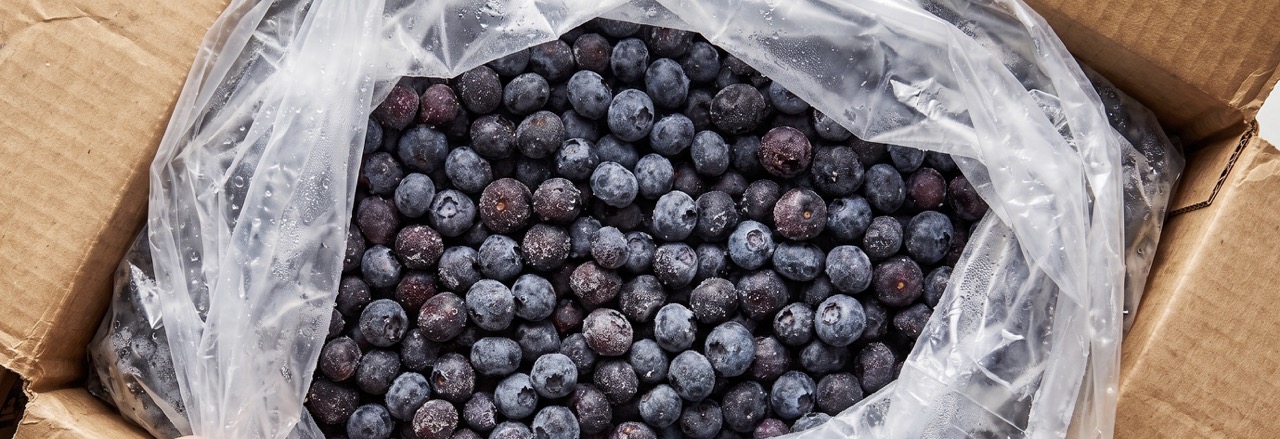
If you buy frozen fruit for a living, you already know blueberries are one of the trickiest SKUs to source well.
They look simple. A blue, round berry. How different can one supplier's blueberries really be from another's?
Very different, it turns out.
Brix can swing by 4-5 points between lots. "Whole" berries can arrive 20% broken. A "Grade A" spec sheet can still hide 8% defects if nobody checked the COA against the actual pallet.
At Patagonia Foods, we move 150 million pounds of fruit a year, and Peru, and blueberries are one of the categories where we see buyers get burned most often, usually because nobody told them what to actually check before the order shipped.
This guide breaks down exactly what to look for when you're sourcing IQF (Individually Quick Frozen) blueberries: the formats available, the specs that actually predict performance in your product, and the buying questions we'd ask if we were sitting in your seat.
Let's get into it.
What "IQF" Actually Means (and Why It Matters for Blueberries)
IQF stands for Individually Quick Frozen. Instead of freezing berries in a block, each berry is frozen separately on a conveyor, usually via blast freezing or fluidized bed freezing, before packing.
Here's why that matters more for blueberries than almost any other fruit:
- Free-flow. Because each berry freezes individually, you can pour exactly the amount you need straight from the bag, with no thawing or chipping required.
- Cell structure protection. Fast freezing forms smaller ice crystals, which do less damage to the berry's cell walls. That means less bleed, better texture retention, and truer color when the fruit is used in a finished product.
- Consistency at scale. IQF is what makes blueberries usable in continuous production, in smoothie lines, bakery inclusion feeders, and dairy blending, where block-frozen fruit would create bottlenecks.
If a supplier can't clearly explain their freezing method (blast vs. fluidized bed, freeze time, core temperature at pack), that's your first red flag. It's one of the first things we walk new buyers through on a facility call, because it affects everything downstream.
The IQF Blueberry Formats You'll Actually Be Buying
Not all "IQF blueberries" are the same product. Before you even get to grade and spec, you need to know which format fits your application. This is one of the first questions our team asks every new customer.
1. Whole IQF Blueberries
The default format, and the one most buyers picture. Whole, intact berries, individually frozen. Used in:
- Bakery inclusions (muffins, bagels, pastries)
- Retail frozen fruit bags
- Yogurt and dairy topping applications
- Foodservice (smoothies, sauces made in-house)
This is where cultivar matters most, since whole-berry appearance and bite are the whole point.
2. Diced / Cut Blueberries
Berries cut into smaller pieces, typically for bakery applications where an even bake-through distribution matters more than whole-berry appearance, think mass-produced muffins and cereal bars.
3. Crushed / Broken Blueberries
An off-grade or intentionally processed format used for purees, sauces, fillings, and juice bases where visual integrity doesn't matter but flavor and color yield do. Priced lower than whole fruit, useful if your application doesn't need a "whole berry" claim.
4. Blueberry Puree (Frozen)
Technically a different product category from IQF, but buyers often compare pricing across both. If your end use is sauce, filling, or beverage base, puree can be more cost-efficient than paying whole-berry pricing and processing it yourself.
Buying tip: If you're being quoted "IQF blueberries" without a format specified, ask. A supplier quoting you crushed fruit at a whole-fruit price point is a real thing that happens, especially on rushed spot-buy orders. We always confirm format in writing before a quote goes out, it should be table stakes, not a courtesy.
Cultivated vs. Wild Blueberries: The Distinction That Changes Everything
This is the single biggest fork in the road when sourcing IQF blueberries, and it affects price, flavor, size, and application fit.
If your marketing leans on antioxidant content or a "superfood" angle, wild blueberries are usually the better fit despite the price premium. If you need consistent size for a bakery inclusion line, cultivated is almost always the right call. Our sourcing team works both categories directly with growers, so we typically walk buyers through this trade-off before they lock in a spec, it's easier to decide upfront than to switch formats mid-launch.
The Quality Specs That Actually Predict Performance
A spec sheet full of numbers is easy to produce. Knowing which numbers actually predict how the fruit performs in your product is the part that takes experience. Here's what we tell our own customers to prioritize.
Brix (Sugar Content)
Measured on a refractometer, Brix tells you the sugar concentration of the fruit. For blueberries, expect a range of roughly 10-16° Brix depending on cultivar, origin, and harvest timing.
Why it matters: Brix affects sweetness, syneresis (how much liquid bleeds out during thaw), and how the fruit behaves when baked or blended. A low-Brix lot in a bakery application can mean a soggier crumb.
Ask for: Brix range guaranteed per lot, not just an average across a season. We report this on every COA we issue.
Size / Count Per Pound
Berry size is typically reported as a diameter range (in mm) or a count-per-pound/kg range. This matters most for:
- Retail visibility (bigger berries photograph and sell better in a clear bag)
- Bakery dosing consistency (uniform size means uniform distribution in dough)
Ask for: A sizing screen breakdown, not just "large" or "small" as a label.
Defect Tolerance
This is where a lot of quality disputes happen. Defects typically include:
- Broken/crushed berries (above the format's intended tolerance)
- Skin split or leaker berries
- Underripe (green/red) or overripe (shriveled) fruit
- Mold or decay
- Foreign material / extraneous vegetable matter (stems, leaves)
A reasonable Grade A / Fancy spec typically caps total defects around 3-5%, with even tighter limits on decay and foreign material specifically. Anything meaningfully looser than that should be reflected in the price, and disclosed up front, not discovered on inspection. This is a standard we hold our own growers to before fruit ever ships.
Moisture / Free Flow
Excess surface moisture leads to clumping ("blocking") in the bag, which is a processing headache on automated lines. Ask whether the fruit is IQF or has been re-frozen/re-packed, since re-processing is a common cause of clumped, non-free-flowing product.
Color and Anthocyanin Content
For applications marketed on nutritional content, anthocyanin level (the pigment responsible for the deep blue-purple color and much of the antioxidant profile) can be tested and reported. Wild blueberries generally test higher here than cultivated.
Microbiological and Food Safety Testing
At minimum, expect a Certificate of Analysis (COA) covering:
- Total plate count
- Yeast and mold
- E. coli / Salmonella / Listeria screening
- Pesticide residue (especially relevant for berries sourced from regions with different regulatory regimes)
The Buying Questions That Matter (Ask These Before You Sign)
Specs on paper are only half the picture. Here's what separates a supplier relationship that scales from one that generates a supply chain crisis six months in. These are the same questions we'd want a buyer to ask us.
1. What's the harvest origin and season for this specific lot?
Blueberries are harvested at different times across hemispheres (Peru: roughly October to February; Chile: November to March; North America: June to September). Ask which harvest and origin you're actually buying, not just "Southern Hemisphere" as a vague answer. With operations in California, Mexico, and Peru, we can usually source across more than one harvest window to keep supply consistent year-round.
2. Can I get a pre-shipment sample against the exact lot, not a "representative" sample?
A "representative" sample from a different production run tells you what the supplier is capable of, not what you're getting. Insist on lot-specific samples for any order above a threshold you're comfortable setting.
3. What food safety certifications does the facility hold?
BRC, SQF, or FSSC 22000 are the standard benchmarks for a serious frozen fruit processor. If a supplier doesn't hold one of these, ask why, and weigh that against your own downstream customer requirements.
4. Is the product organic-certified, and is that certification traceable to the actual lot?
Organic claims require documentation trail all the way to the farm. Ask for the certificate and confirm the certifying body is recognized in your market (USDA, EU Organic, etc.).
5. What's the cold chain documentation from freezing through delivery?
Temperature excursions during transit or storage degrade texture and shelf life even if the fruit tested fine at origin. Ask for temperature logs, not just a verbal assurance the cold chain was maintained.
6. What are the packaging options, and do they fit my process?
Common formats: 10kg (22lb) poly-lined cartons, 1,000kg/2,000lb totes/bins, and retail-ready bags. Confirm case dimensions and pallet configuration match your receiving and storage setup before you order, not after the truck arrives.
7. What's the minimum order quantity, and what's the lead time from confirmed order to delivery?
Spot-market pricing on frozen fruit moves with the season. A supplier who can't tell you their actual lead time, separate from "when the price is good," is telling you something about how they manage inventory.
8. Who do I call if a lot doesn't meet spec on arrival, and what's the resolution process?
Get this in writing before there's a problem, not after. Ask specifically: is there a claims window, what documentation do you need to submit, and what's the typical resolution (credit, replacement, discount)?
9. Can pricing and specs be locked for a defined contract period, or is everything spot-priced?
If you're building a product line around blueberries as a core ingredient, spot pricing alone creates margin risk. Ask whether the supplier offers any forward-contract or fixed-price options tied to volume commitments.
10. How many pounds of blueberries does this supplier move in a typical year?
Volume is a rough proxy for both buying power (better grower relationships, more consistent quality) and operational maturity, since they've likely already solved the logistics problems you haven't hit yet.
Putting It Together
The fastest way to get burned on an IQF blueberry order isn't a bad supplier, it's an unclear spec. Format, cultivar, Brix, defect tolerance, and origin all move independently of each other, and a quote that looks cheap on price per pound can be expensive once you account for what's actually in the bag.
Before your next order, get three things in writing: the exact format and cultivar, a lot-specific COA, and a defined resolution process if the delivered product doesn't match it. Everything else is negotiable. Those three aren't.
If you'd rather skip the back-and-forth and just get fruit sourced direct from growers, reach out to our team. We're happy to walk through specs, send samples, and put together a quote against your exact application.

