


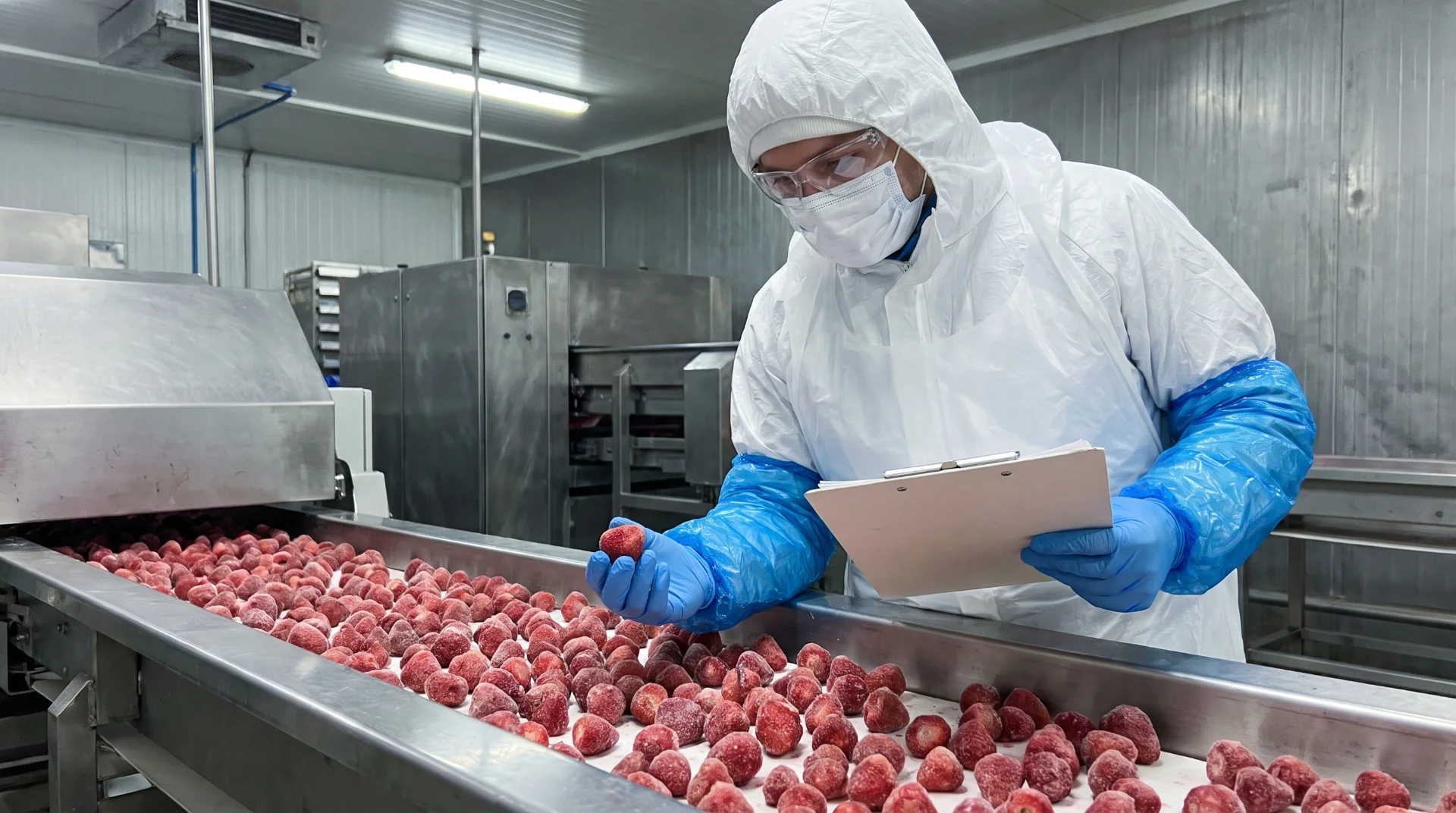
A supplier's spec sheet says "GFSI certified." Another lists FSSC 22000, AIB, Kosher and USDA Organic. A third shows an ISO 9001 seal and an ANAB logo.
Are they all saying the same thing?
No. GFSI doesn't certify anyone. It recognizes certification schemes, and "GFSI certified" means a site is certified to one of those schemes. The other logos on a spec sheet cover different things entirely: quality management, plant inspections, kosher status, organic production, or the accreditation of the auditors themselves.
In this guide, you'll see what GFSI certification actually means, which schemes it recognizes, what each of the common marks on a frozen fruit spec sheet tells you, and how to check that a certificate is real and current.
Let's dive right in.
Table of Contents
- What Is GFSI Certification?
- GFSI-Recognized Certification Schemes
- FSSC 22000, Explained
- Other Marks You'll See on a Spec Sheet
- How to Check a Supplier's Certificate
- FAQ
What Is GFSI Certification?
GFSI stands for the Global Food Safety Initiative. It doesn't audit food plants or issue certificates. Instead, it sets benchmarking requirements and checks certification schemes against them. Schemes that meet the bar are "GFSI-recognized."
GFSI is clear on this point: its benchmarking requirements are not a standard, and food businesses can't be audited or certified against them (GFSI).
So when a supplier says "GFSI certified," what it really means is: this site holds a certificate to a GFSI-recognized scheme, such as FSSC 22000, SQF or BRCGS. The certificate itself comes from an independent certification body, not from GFSI.
Buyer tip
If a spec sheet only says "GFSI certified," ask which scheme. The scheme name tells you which rules the site was audited against and where to verify the certificate.
GFSI-Recognized Certification Schemes
GFSI lists the certification programme owners it recognizes on its website. They include:
- BRCGS
- CanadaGAP
- Freshcare
- FSSC 22000
- Global Red Meat Standard
- Global Seafood Alliance
- GLOBALG.A.P.
- GRMA
- IFS (International Featured Standards)
- Japan Food Safety Management Association
- PrimusGFS
- SQF
Source: GFSI, Recognised Certification Programme Owners. Recognition can change, so check GFSI's current list.
Three you'll often see on North American spec sheets are FSSC 22000, SQF and BRCGS. Many buyer supplier-approval programs ask for certification to a GFSI-recognized scheme rather than naming one specific scheme, which is why the GFSI label carries so much weight.
FSSC 22000, Explained
FSSC 22000 is one of the GFSI-recognized schemes, and it's built from three parts:
- ISO 22000, the international standard for food safety management systems
- Sector-specific prerequisite programs (PRPs), covering basics like hygiene, cleaning and pest control for that type of operation
- Additional FSSC scheme requirements on top of both
Certification runs on a three-year cycle, with annual surveillance audits and a recertification audit. At least one surveillance audit in each cycle is unannounced (FoodChain ID; TQCSI, FSSC 22000 V6 rules of certification).
One common mix-up: ISO 22000 on its own is not GFSI-recognized. FSSC 22000 is. If a certificate says ISO 22000 without FSSC, it doesn't meet a "GFSI-recognized scheme" requirement by itself.
Version note: FSSC 22000 Version 7 was released in May 2026. According to DNV, Version 6 remains valid until a 12-month transition begins in 2027 (DNV). That's one reason to check the version printed on any FSSC certificate.
Other Marks You'll See on a Spec Sheet
Not every logo on a spec sheet is a food safety certification, and none of these is a GFSI scheme. Here's what each one actually covers:
| Mark | What it covers | What it doesn't tell you |
|---|---|---|
| ISO 9001 | The quality management system: documented processes, corrective action, monitoring and measurement. | It isn't a food safety standard, and it doesn't certify the product itself. |
| AIB International inspection | A scored inspection of the facility in five categories. | An AIB inspection is not a GFSI-recognized certification. |
| Kosher (e.g. OK Kosher) | That the product meets the certifying agency's kosher requirements. | It isn't a food safety certification. |
| USDA Organic | That the product was produced and handled under the USDA organic regulations. | It isn't a food safety certification. |
| ANAB | Accreditation of the organizations that do the checking, like certification bodies and labs. | ANAB doesn't certify food companies. |
ISO 9001
ISO 9001 certifies a quality management system, not the fruit. An auditor checks that processes are documented, that problems get corrective action, and that performance is monitored and measured. It applies to any industry, which is why you'll see it on everything from fruit to machine parts.
AIB International
AIB International inspections score a facility out of 1,000 points, with 200 points in each of five categories (Industrial Packaging; Quality Assurance & Food Safety):
- Operational and personnel practices
- Maintenance for food safety
- Cleaning practices
- Integrated pest management
- Adequacy of prerequisite and food safety programs
The exact category names vary slightly between editions of AIB's standards.
Because it's scored, ask for the actual score and the date of the inspection, not just the logo.
Kosher
If your finished product will carry a kosher symbol, your own kosher certifier will need to approve every ingredient that goes into it. OK Kosher, for example, requires ingredients to be submitted for verification and approval before they're received and used (OK Kosher). Fruit that's already certified by a recognized agency makes that approval easier.
USDA Organic
Under the USDA organic regulations, the land a crop is grown on must have had no prohibited substances applied to it for 3 years immediately before harvest (7 CFR 205.202). Operations that produce and handle the product through the supply chain are certified by USDA-accredited certifying agents, with some exemptions. Since March 19, 2024, every organic shipment imported into the U.S. also needs an NOP Import Certificate (CCOF).
ANAB
ANAB, the ANSI National Accreditation Board, accredits the organizations that do the auditing and testing. That includes management system certification bodies (ISO/IEC 17021-1), product certification bodies (ISO/IEC 17065), and testing and calibration laboratories (ISO/IEC 17025) (ANAB). In other words, it checks the checkers.
How to Check a Supplier's Certificate
A logo on a spec sheet is a claim. The certificate is the proof. Ask for a copy and check four things:
Step #1: The scheme and version
"FSSC 22000 Version 6" is specific. "GFSI certified" is not.
Step #2: The site it covers
Certificates cover specific sites. A certificate for one plant doesn't cover a different plant owned by the same company.
Step #3: The products in scope
The scope statement lists the products and processes covered. Make sure the product you're buying is in it.
Step #4: The expiry date
Certificates expire. Note the date and ask for the renewed certificate when it comes due.
Then confirm the certificate in the scheme's or certifier's online database. Most schemes publish one, such as the FSSC 22000 public register and the BRCGS Directory. For organic, use the USDA Organic Integrity Database.
FAQ
What does GFSI stand for?
GFSI stands for the Global Food Safety Initiative. It benchmarks food safety certification schemes and recognizes the ones that meet its requirements.
Is GFSI certification required by law?
No. GFSI recognition is a market requirement, not a legal one. It's usually required by buyers as part of their supplier approval programs. Legal food safety requirements in the U.S. come from regulators such as the FDA and USDA.
Is ISO 22000 GFSI-recognized?
Not on its own. FSSC 22000, which builds on ISO 22000 with prerequisite programs and additional scheme requirements, is GFSI-recognized.
How often are FSSC 22000 sites audited?
Certification runs on a three-year cycle with annual surveillance audits and recertification, and at least one surveillance audit in each cycle is unannounced.
Is an AIB inspection the same as GFSI certification?
No. An AIB inspection is a scored facility inspection. It isn't a GFSI-recognized certification scheme.
The Bottom Line
GFSI doesn't certify anyone. It recognizes schemes like FSSC 22000, SQF and BRCGS, and those schemes certify sites. The other logos on a spec sheet each cover something different, so read them for what they are, ask for the certificate, and verify it in the scheme's or certifier's database.
Reviewing a frozen fruit supplier? See the certifications that apply to our products on our certifications page, learn how our QA team checks fruit on our quality page, or request a quote and our team will send the documentation you need.
Sources
- GFSI: Recognised Certification Programme Owners
- FoodChain ID: FSSC 22000
- TQCSI: Rules of Certification, FSSC 22000 V6
- DNV: FSSC 22000 Version 7 released
- Industrial Packaging: What Does a 980 AIB Audit Score Tell You?
- Quality Assurance & Food Safety: AIB releases new standards
- OK Kosher: Navigating Your Kosher Certification Program
- 7 CFR 205.202: Land requirements (organic)
- CCOF: NOP Import Certificates
- ANAB: About ANAB

