


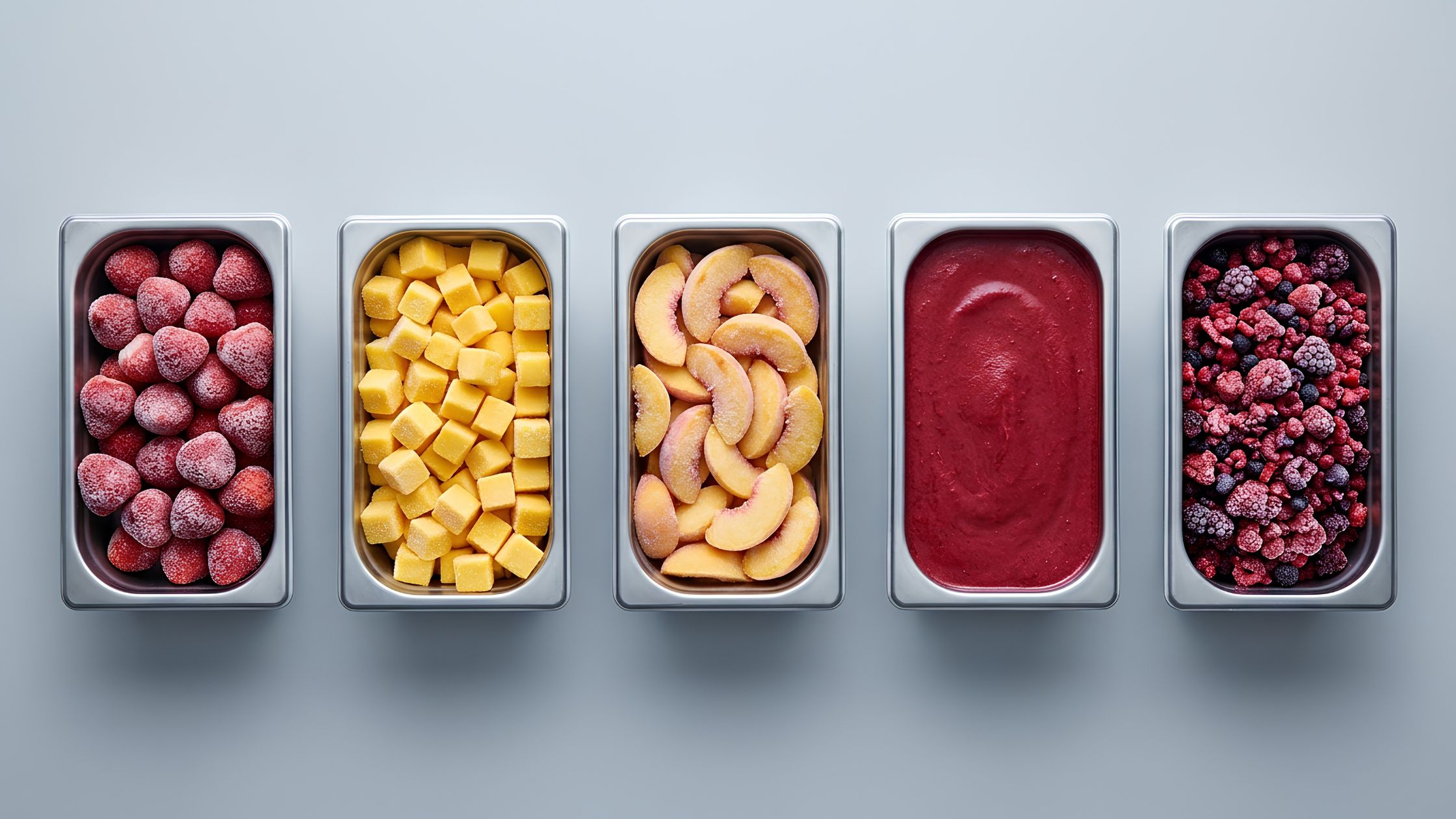
If you've ever requested a quote from a frozen fruit supplier, you've probably noticed the same question comes up early: what format do you need? It's not a throwaway detail. The format you choose affects everything downstream, from how the fruit performs in your process to how much you pay per kilo.
Most buyers know they need "frozen strawberries" or "frozen mango." Far fewer have thought through whether whole, diced, sliced, or puréed fruit actually fits their production line. That gap is where costly mistakes happen: reworked batches, unexpected thawing steps, or fruit that breaks down when it shouldn't.
This guide breaks down the main IQF (individually quick frozen) fruit formats, what each one is actually good for, and how to figure out which one belongs in your next purchase order.
What "Format" Actually Means in Frozen Fruit
Format refers to the physical form the fruit is in when it's frozen: whole, cut into pieces, crushed, puréed, or reduced to powder. It's separate from grade or variety, though buyers sometimes lump all three together when they ask for a quote.
Two products can be the same fruit, same variety, same quality tier, and still behave completely differently in a factory simply because one is diced and the other is puréed. Format is a process decision as much as a purchasing one.
Tip for buyers: Before you request a quote, map out exactly where the fruit enters your production line and what happens to it in the first 10 minutes after it thaws. That single step usually tells you which format you actually need.
Whole IQF Fruit
Whole format means the fruit is frozen as a single, unbroken piece: a whole strawberry, a whole blueberry, an entire mango cheek in some cases. Each piece is individually frozen rather than frozen in a block, so pieces stay separate and free-flowing in the bag.
This is the format most buyers picture when they think of frozen fruit, and it's usually the starting point for retail-facing products, smoothie mixes, and any application where the fruit's shape needs to stay recognizable.
Whole fruit gives you the most flexibility downstream. You can dice it, slice it, purée it, or use it as-is once it arrives, which makes it a reasonable default when you're not yet certain how the fruit will be processed.
The trade-off is yield. You're paying for the whole piece, including parts your process may not use, and you're taking on the labor or equipment cost of any further cutting yourself.
Diced and Sliced Fruit
Diced fruit is cut into small, uniform cubes before freezing. Sliced fruit is cut into flat pieces, typically for fruit like strawberries, peaches, or mango where a slice shape matters for the finished product.
Both formats exist because cutting fruit after it's frozen is slow, damages the product, and is hard to standardize. Cutting before freezing lets the supplier control piece size precisely and keep it consistent across every batch.
This matters more than it sounds. If you're running an automated filling line for yogurt cups or baked goods, piece-size variation can jam equipment or throw off your fill weights. A supplier working from tight sizing tolerances, not a rough visual estimate, is doing you a real favor here.
What to ask a supplier: Request the actual dice or slice specification, in millimeters, not a general description like "small dice." A written spec is something you can hold them to; "small" is not.
Diced and sliced formats are the standard choice for bakery inclusions, foodservice toppings, and any product where the fruit needs to distribute evenly through a batter, filling, or topping mix.
Crushed and Broken Fruit
Crushed fruit sits between diced and puréed. The pieces are irregular, partially broken down, and often include some juice released during processing. This format usually shows up as a byproduct grade or as an intentional choice for jams, sauces, and fillings where texture doesn't need to be uniform.
It's worth asking directly whether a "crushed" quote is intentional crushed-grade fruit or simply broken pieces sorted out of a whole or diced run. The two can carry different pricing and different consistency from batch to batch.
Purée
Purée is fruit that's been fully broken down into a smooth, pumpable consistency and frozen, usually in blocks, drums, or aseptic bags depending on volume. There's no piece structure left to describe: what you're buying is the fruit's flavor, color, and body in liquid or semi-liquid form.
Purée is the standard input for beverages, smoothies, sauces, dairy inclusions, and any product where the fruit needs to blend seamlessly rather than stand out as a distinct piece.
Because purée has no piece structure to protect, suppliers can be more precise about consistency metrics that matter for formulation, particularly Brix (a measure of sugar content, where a higher Brix reading means more natural sweetness) and viscosity. If your recipe depends on hitting a specific sugar or acidity target, purée is where that precision is easiest to source.
Callout: Reading a purée spec sheet Look for three numbers before you buy: Brix, pH, and viscosity range. Together they tell you how the purée will behave in your formulation, not just how it tastes on its own.
Powder
Fruit powder is made by dehydrating fruit or fruit purée and grinding it into a fine, shelf-stable form. It's technically not frozen at all, but it's worth mentioning here because buyers evaluating formats often compare it against IQF and purée options for the same application.
Powder is lightweight, has a long shelf life without cold storage, and is easy to dose precisely in dry-mix applications like protein powders, baking mixes, and flavoring systems. What you lose is fresh fruit texture and some of the volatile flavor compounds that dehydration drives off.
If your product needs shelf stability and precise dry-blend dosing more than it needs fresh fruit character, powder deserves a real look, even if your instinct was to default to frozen.
Matching Format to Your Production Line
The right format isn't the one that sounds highest quality. It's the one that matches how your line actually handles the fruit.
A few starting questions that tend to point buyers in the right direction:
Does the fruit need to stay visually intact in the finished product? If yes, whole or sliced format. If the fruit disappears into a batter, sauce, or beverage, purée is usually more efficient and often cheaper per usable kilo.
Does your equipment require uniform piece size to run without jamming? If yes, diced or sliced fruit with a documented sizing tolerance, not whole fruit you plan to cut yourself.
Do you need a specific Brix or acidity target for formulation? Purée gives suppliers the most control here, since there's no piece variability to average out.
Does the product need to be shelf-stable without cold storage? That points toward powder, not any frozen format.
What's your actual usable yield on whole fruit once you account for trim, pits, or stems? If it's low, a pre-processed format like diced or purée may be cheaper on a usable-kilo basis even at a higher quoted price per kilo.
Tip for buyers: Ask any supplier for their yield or usable-kilo comparison across formats, not just a price per kilo. A slightly more expensive diced or purée product often works out cheaper once trim loss is factored in.
What Doesn't Change Across Formats
Regardless of which format you choose, a few things should stay consistent from a reliable supplier: a certificate of analysis (COA) specific to the lot you're receiving, cold chain documentation showing the fruit stayed at temperature from freezing through delivery, and clear communication about seasonal availability for the fruit and format you need.
Format changes how the fruit behaves in your process. It shouldn't change whether you can trust what's in the bag.
Choosing the Right Format, Confidently
There's no universally "best" frozen fruit format. There's only the format that fits your specific production line, your formulation targets, and your cost structure once yield is accounted for.
If you're not sure which format your process actually needs, that's a normal place to start from, not a sign you're behind. A supplier worth working with will ask about your process before recommending a format, not the other way around.
Have questions about which format fits your production line, or need a spec sheet for a specific fruit and format? Reach out to our team, or request a quote to get pricing across formats for your next order.

