


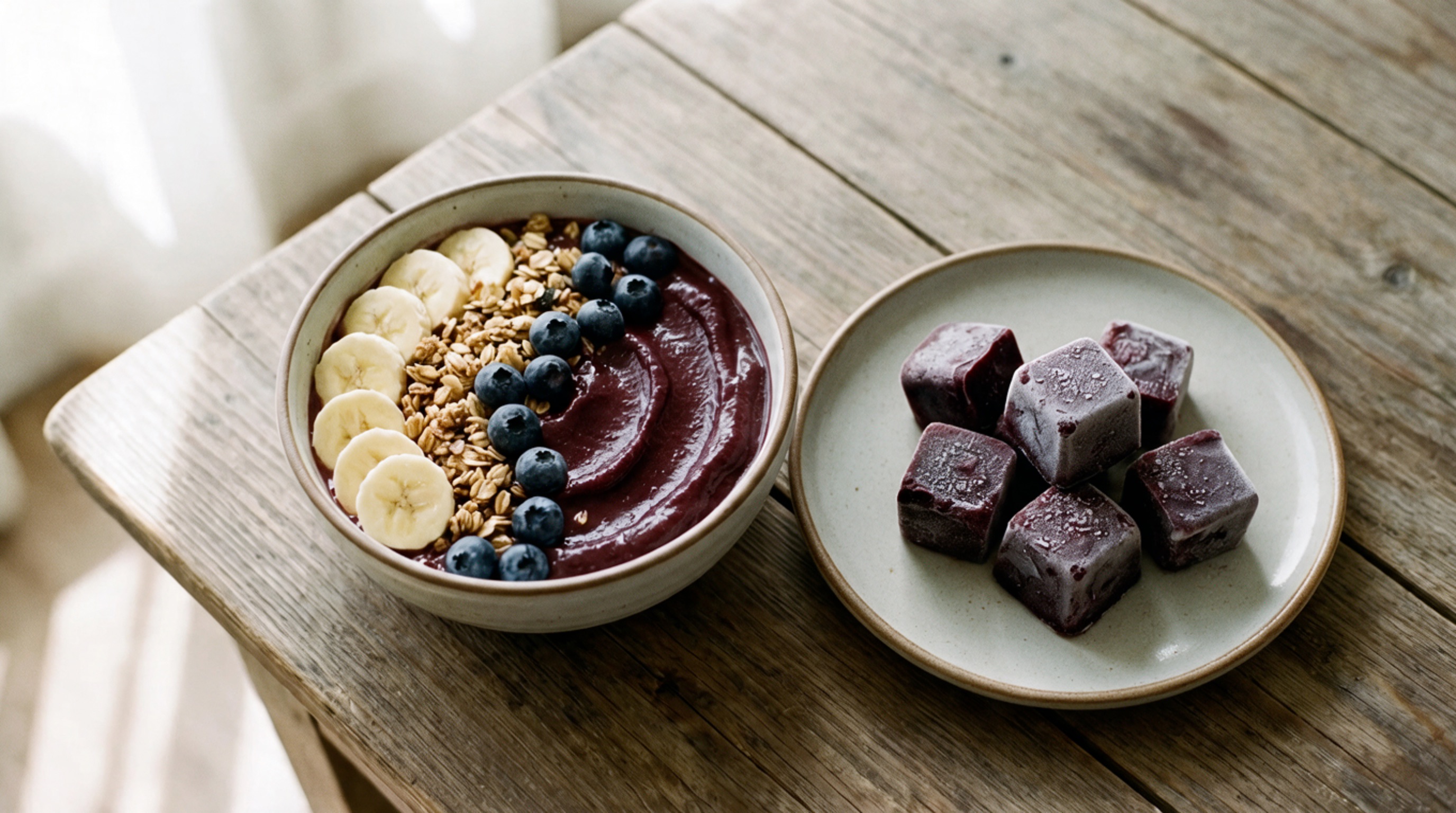
Most people who eat açaí bowls have no idea what's actually in açaí. They know it's purple, they know it's "healthy," and that's about it.
Here's the thing that surprises almost everyone: açaí isn't a sugary fruit. It's a fatty one. That's the opposite of what you'd guess from a fruit, and it changes how you should think about it.
How many calories are in a serving of açaí?
A 100 gram serving of plain, unsweetened frozen açaí puree runs about 60 to 85 calories. That's roughly double what you'd get from the same amount of unsweetened strawberry or mango.
It's not because açaí is processed or loaded with something weird. It's just a naturally fatty fruit, which is unusual. Most fruit calories come from sugar. Açaí's calories mostly come from fat.
Here's the general breakdown for 100 grams of unsweetened açaí puree:
Calories: 60 to 85 Fat: 4 to 7 grams Carbs: 2 to 6 grams Fiber: 2 to 3 grams Sugar: under 2 grams, and none of it added Protein: 1 to 2 grams
Those numbers are for plain, unsweetened puree. The açaí bowl you get at a smoothie shop is a different story, because it's usually blended with juice, banana, honey, and granola on top. None of that comes from the açaí itself.
Why does açaí have so much fat?
Açaí grows on palm trees, not on a bush or a vine like most berries. The fruit's pulp is naturally rich in fat, mostly the same kind of monounsaturated fat you'd find in olive oil.
That's a good kind of fat to be eating. It's also why açaí has that thick, almost creamy texture instead of being watery like a raspberry or a grape. And because fat digests slower than sugar, a small serving tends to feel more filling than the calorie count would suggest.
Is açaí actually low in sugar?
Yes, and this is the part most people get wrong. Pure açaí, with nothing added to it, usually has less than 2 grams of sugar per 100 gram serving. All of it occurs naturally in the fruit.
That's noticeably lower than mango, grapes, or even blueberries. Açaí on its own actually tastes a little earthy and tart, not sweet. If you've had a sweet açaí bowl, that sweetness came from the juice or honey mixed in, not the berry.
What about fiber and other nutrients?
A typical serving has 2 to 3 grams of fiber, which is solid for a fruit portion that size. Açaí is also known for its antioxidants, specifically anthocyanins, the same compound that gives blueberries and dark grapes their color.
One thing açaí is not known for is vitamin C. If you're eating it for vitamin C the way you might eat an orange, you're not getting much. Its strengths are the fat, the fiber, and the antioxidants, not the vitamin content.
Why do nutrition labels vary between brands?
If you compare labels from a few different açaí products, the calorie and fat numbers won't always match, even when every label says "100% pure, unsweetened."
That usually comes down to how concentrated the puree is. Some brands sell pulp that's almost entirely açaí. Others cut it with some water before freezing, which lowers the calorie and fat numbers but also mellows out the flavor.
Neither one is automatically better. A lower calorie açaí product isn't necessarily healthier. It might just be more diluted.
The bottom line
A normal serving of plain açaí, around 100 grams, is a reasonable everyday amount. It adds fiber, healthy fat, and antioxidants to a smoothie or bowl without turning it into a huge calorie bomb by itself.
If your açaí bowl is a calorie bomb, it's almost never the açaí's fault. It's the granola, the honey, the extra banana, and the juice it got blended with.
Sourcing pure, unsweetened IQF açaí for your kitchen or your product line? Request a quote or reach out to our team and we'll help you find the right fit.

